You have created a Local Energy Community, or you are preparing one, and you are looking for someone to run it day to day?
Celium takes care of your LEC's settlements, billing and payment collection.
This page describes precisely what the service covers, what it does not cover, and what it costs.
Delegated management is aimed at those who run an LEC without wanting to take on its day-to-day administration.
In every case, each participant remains a customer of their DSO for residual electricity,
and there is no position to create within the community: Celium handles the operation.
Municipalities
You run a municipal LEC or a project around your public buildings,
and you want to delegate its operation without creating a dedicated administrative position.
Property managers
Owners or tenants in your portfolio take part in an LEC,
and you do not want to bring energy billing and its follow-up in house.
Condo associations
Your condominium produces solar energy and shares it with the neighbourhood,
but the committee does not want to draw up the settlements itself.
Building owners
Your buildings are equipped with solar panels and you want to get value from the surplus
through an LEC, without extra administrative workload.
Service scope
A clear mandate starts with a clear scope. Here is what delegated management covers, and what it does not.
Included in the mandate
Reception and verification of the metering data transmitted by the DSO: SDAT-CH (XML) or CSV files, readings at 15-minute intervals.
Calculation of the allocation of the shared electricity: internal flows measured by the DSO where available, otherwise pro-rata allocation at 15-minute intervals.
Internal prices calculated automatically from the DSO's reference tariffs, recalculated at every tariff adjustment. They are never negotiated.
Billing by period (quarterly by default, configurable) with Swiss QR-bills, payable by e-banking or at the counter.
Payment tracking: automatic bank reconciliation (camt.054) and staged email reminders in case of late payment.
Payouts to producers, accompanied by a detailed statement of the value obtained for their surplus.
Online member area for each participant: dashboard updated the day after, bills, consumption history. Available in French, English and German.
Email support for the participants and for the project owner.
Outside the scope
Installing and maintaining the solar systems. Panels, inverters and batteries are your installer's responsibility. The Swissolar directory lists certified professionals.
Meters and metrology. Installing and replacing the smart meters, reading them and ensuring their accuracy are the DSO's responsibility; installation is at the DSO's expense, with no installation cost to participants (the cost is recovered through its metering tariff, as for all its customers). Celium consumes the measured data, it does not measure anything itself.
Individual contracts with the DSO. Each participant keeps their own contract for residual electricity. Celium does not replace it and never becomes your electricity supplier.
This scope is deliberately explicit: it is what makes the mandate verifiable.
If your need falls outside this framework, tell us and we will point you in the right direction.
Who does what: the DSO and Celium
An LEC involves two players with clearly distinct roles.
Celium never replaces the DSO: the grid, the meters and the supply contracts remain its responsibility.
Area
Role of the DSO
Role of Celium
Meters and measurement
Installs the smart meters at its own expense (no installation cost to participants, cost included in its metering tariff) and reads consumption at 15-minute intervals.
Receives and verifies the transmitted metering data.
Grid
Operates the grid, delivers the electricity and applies the grid discount (40% or 20%) to the shared electricity.
Includes this discount in the calculation of the value created and of the internal prices.
Residual electricity
Bills each participant under their individual contract.
Plays no part in these contracts.
Shared electricity
Transmits the community's metering data.
Calculates the allocation, draws up the settlements and the LEC's internal QR-bills.
Internal payments
No role.
Collects the bills, sends the reminders, pays the producers their share.
Participant information
Usual bill for the residual electricity.
Trilingual member area, dashboard updated the day after, email support.
Data and interoperability
Celium works with the standard formats of the Swiss electricity and banking sectors.
No software to install, no proprietary format required.
Accepted metering formats
SDAT-CH (the Swiss standard for exchanging metering data, in XML)
and the CSV exports of the DSOs, each with its own format.
Metering points
Each participant is identified by their Swiss metering point number
(33 characters, starting with CH), as it appears on the DSO's bill.
Billing and collection
QR-bills compliant with the Swiss standard, payable by e-banking or at the counter.
Automatic bank reconciliation via camt.054 files (ISO 20022).
Hosting and data protection
Data hosted in Switzerland and processed in accordance with the Swiss FADP (nLPD).
Your community remains the owner of its LEC's data.
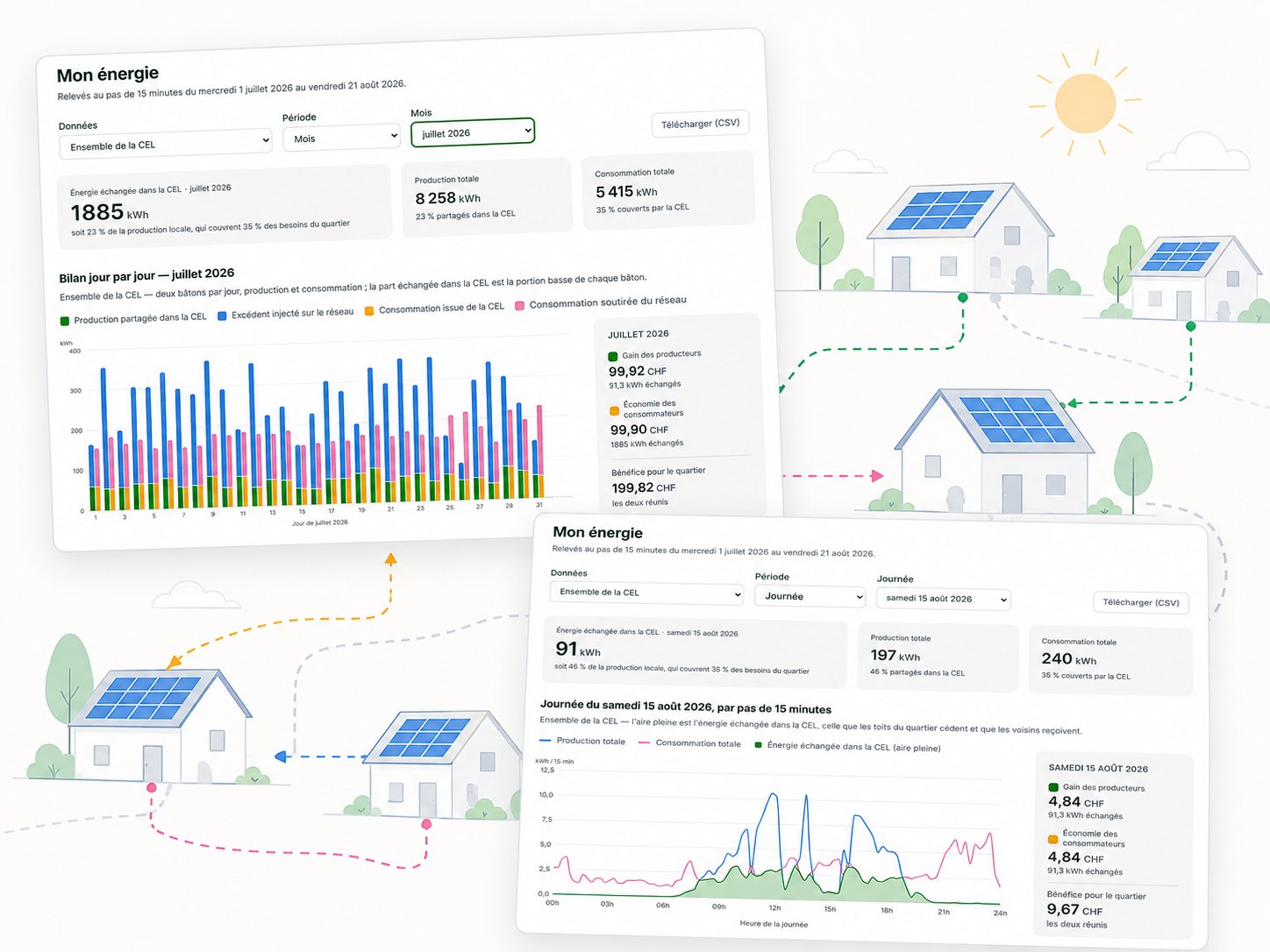
The Celium member area: here, production, consumption and energy shared within the LEC in 15-minute steps. Each member also sees their own data. Real example from an LEC (interface shown in French).
Service languages
The service is available in French, English and German: website, member area and notification emails.
The terminology follows the usage of each language: CEL in French, LEG in German (Lokale Elektrizitätsgemeinschaft),
LEC in English (Local Energy Community).
Pricing: the 40/40/20 model
The price of delegated management is the same as for any LEC managed by Celium, with no exceptions and no surcharges.
40 ct
to the producers
of every franc of value created by the LEC
40 ct
to the consumers
of every franc of value created by the LEC
20 ct
for Celium
funding the complete operation of the LEC
Launch offer · until 31 October 2026
For any management mandate submitted by 31 October 2026, Celium's share is halved during the first twelve months
of operation: 45 cents to producers, 45 cents to consumers, 10 cents to Celium
per franc of value created, then 40/40/20. Also valid when taking over an existing LEC.
Details.
No set-up fees, no fees for taking over an existing LEC, no subscription.
Celium's remuneration is taken only on the value actually measured at settlement:
no value created, no Celium fee. Amounts excluding VAT.
The LEC's internal prices (surplus buy-back and resale to consumers) are calculated automatically
from the DSO's reference tariffs and recalculated at every tariff adjustment. They are never negotiated.
From first contact to routine operation, here are the stages of a delegated management mandate.
The set-up time depends mostly on the DSO (activation of the metering and transmission of the data);
we give you a realistic estimate during the scoping phase.
1
First contact
You describe your situation: existing LEC or project, DSO involved, number of participants, production installations.
2
Scoping
List of metering points, sharing perimeter, verification of what the DSO provides (measured internal flows or individual readings) and of the mandate's terms.
3
Set-up
Celium registers the LEC, its participants and the DSO's tariffs. Each participant receives access to their member area.
4
First data cycle
The first DSO readings are imported and verified; the dashboards start to fill up.
5
First settlement
At the end of the first period, each consumer receives their QR-bill and each producer their payout statement, with the details of the calculation.
6
Routine operation
Regular settlements, automatic reminders and payouts. You follow everything from your member area, with no administrative tasks.
The cases where Celium is not the right choice
A service is also defined by its limits. Here are two situations in which we will tell you
honestly that Celium is not the right solution.
A self-consumption grouping (ZEV) is enough for your needs
If sharing is limited to one building or to a group of buildings behind the same connection point,
a self-consumption grouping (ZEV in German) is often simpler than an LEC: the electricity does not pass through the public grid
and no LEC settlement is needed. We will tell you during the scoping phase, but managing a pure ZEV
is not our service.
You want to handle the billing yourself
If your community wishes to draw up its own settlements with its own tools,
you do not need a management mandate. The legal framework allows it;
it is simply a different organisational choice from ours.
Frequently asked questions from project owners
Who is the DSO's point of contact when Celium manages the LEC?
The community remains the holder of its procedures with the DSO (registration of the LEC, grid usage agreement).
Celium prepares these procedures, follows up the exchanges and manages the reception of the metering data.
The individual supply contracts for residual electricity remain between each participant and the DSO.
What happens if a participant does not pay their LEC bill?
Celium sends staged reminders by email, then reports persistent unpaid bills to the project owner
with the detailed amounts. Substantive decisions, such as a payment plan or an exit from the community,
remain the LEC's responsibility; Celium provides the settlements and the history needed.
Is the management mandate reversible?
Yes. The mandate can be terminated under the conditions set during the scoping phase, typically at the end of a settlement period.
Your LEC's data (participants, meter readings, settlements) is returned to you in standard formats.
Since there is no subscription and no fixed fees, no minimum term is needed to amortise initial costs.
How are the LEC's internal prices set?
They are calculated automatically from your DSO's reference tariffs, following the 40/40/20 model,
and recalculated at every tariff adjustment. Two public references serve as the basis: the sale price
published by ElCom for your municipality, for the standard product of category H4 (typical household), and
the buy-back price your DSO publishes at the end of each quarter for surplus solar, guarantees of origin
included. They are never negotiated, neither by Celium nor by the community:
this is what guarantees a fair and verifiable sharing of the value created.
Who owns the LEC's data?
Your community. Metering and billing data is hosted in Switzerland and processed
in accordance with the Swiss FADP (nLPD). Celium uses it only to operate your LEC and returns it
to you if the mandate ends.
Our LEC already exists and is billed differently. Does the takeover cost anything?
No. There are no set-up fees and no takeover fees. Celium's remuneration remains 20%
of the value created, measured at settlement, from the moment Celium operates the LEC.
With the launch offer (mandates submitted by 31 October 2026), this share is 10% during the first
twelve months of operation.
Does Celium also support LEGs in German-speaking Switzerland?
Yes. Celium works entirely in German (website, member area, emails) and supports LEGs
across Switzerland, with priority on the grids already covered by its map (BKW, EKZ, Primeo Netz,
WWZ, St.Galler Stadtwerke). Our first communities are in French-speaking Switzerland, and we say so:
for the first project on a new grid, aligning your DSO's data formats may take a little longer,
and support is provided in standard German. Tell us about your project and we will tell you
frankly how we can support it.
Delegated management
Let's talk about your LEC
Describe your situation: municipality, property manager, condo association or owner, existing LEC or project, DSO involved.
We reply within 48h, including when the honest answer is that Celium is not the right choice for you.