Celium covers the entire lifecycle of your Local Energy Community:
matching with your neighbours, guided setup, automated billing.
Since 1 January 2026, Swiss federal law has allowed neighbours in the same municipality to share their solar electricity over the public grid, with a 20 to 40% discount on grid usage charges.
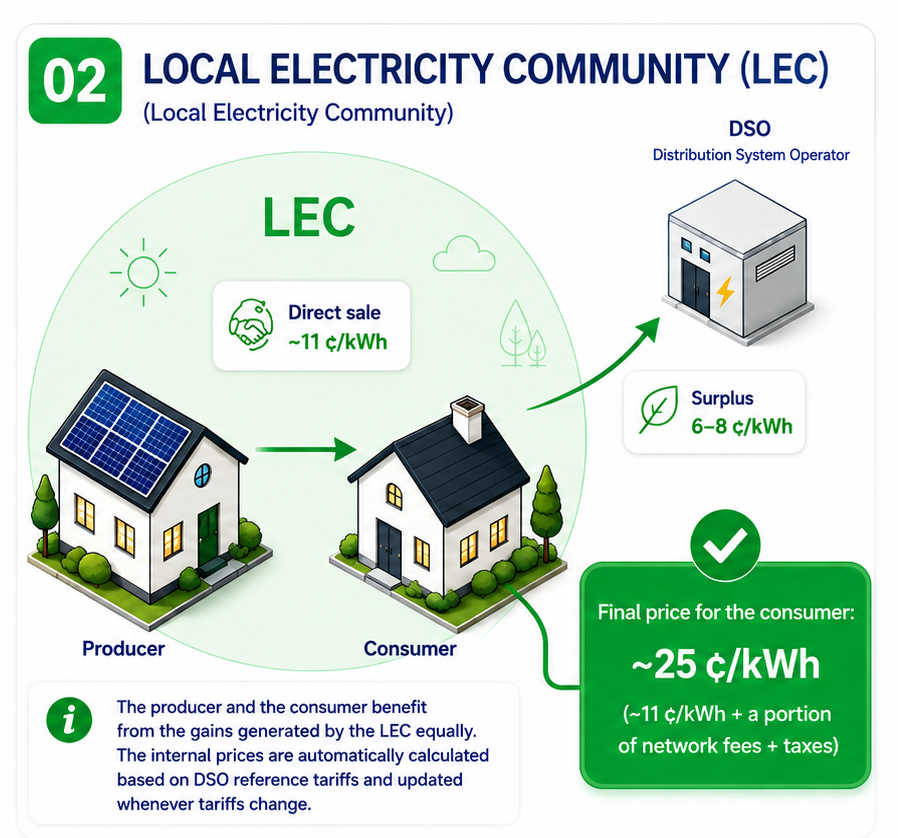
Neighbours with solar panels
produce electricity that they don't consume entirely
They share the surplus with their neighbours
over the existing public grid, at a price they negotiate between themselves
Everyone wins
the producer sells at a higher price, the consumer pays less, and the energy stays local
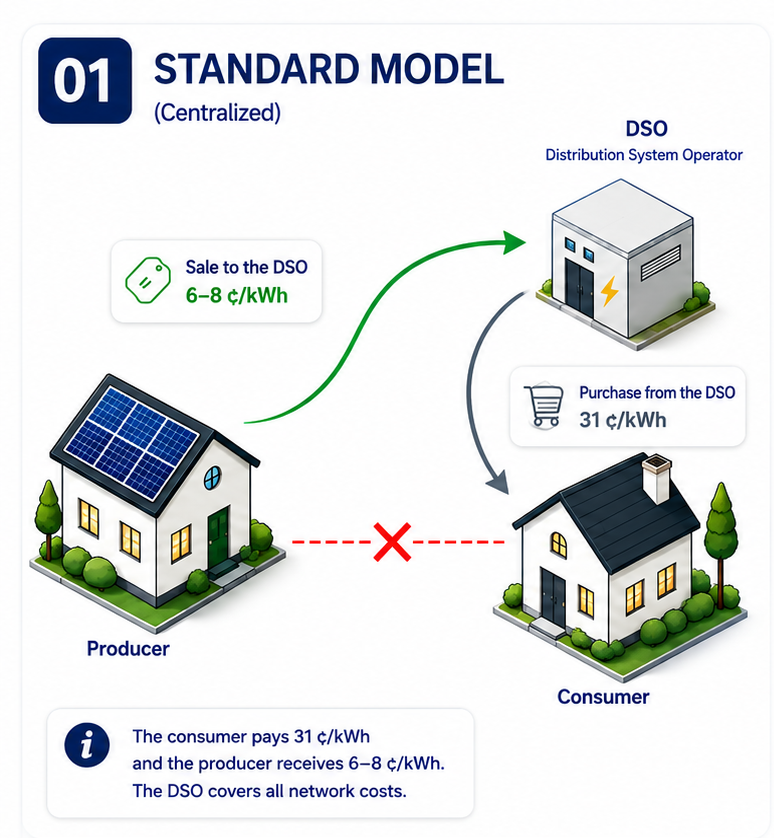
Compare the standard (centralised) model with the LEC model and discover the concrete savings for producers and consumers.
In this example, the LEC members have jointly agreed on a price of 10 ct/kWh for the solar energy exchanged locally, a freely negotiated rate that benefits both parties.
Enter your situation to get a personalised estimate of your annual savings with an LEC.
Average Swiss household: ~4'500 kWh/year
Depends on local solar production and your profile
Your estimated annual saving
Bill without LEC
CHF 1'395
Bill with LEC
CHF 1'288
Estimated additional income
Income without LEC
CHF 94
Income with LEC
CHF 229
Indicative estimate based on average tariffs. ElCom source
Energy part of the supplier tariff (excluding grid and taxes)
Price negotiated between members
Buy-back of the surplus by the electricity supplier
Grid usage charges before discount
Grid surcharge, Swissgrid, etc.
From the first spark to day-to-day management, Celium supports you at every step.
Submit your profile in 2 minutes. Celium automatically finds compatible neighbours in your grid zone and checks the legal criteria.
Celium checks whether you are on the same grid as your neighbours and the applicable discount rate (40% or 20%).
Before any commitment, Celium calculates your projected savings based on your consumption, your role and the applicable discount zone.
Topology requests, registration, agreement with digital signature: Celium handles all the procedures.
Celium sets the fair price for the solar energy exchanged within the LEC, taking into account the electricity supplier's tariff, the self-consumption share and the production profile.
Your LEC gets a public page on Celium where interested neighbours can apply online. You can also keep it private.
Import your DSO data. Celium calculates the allocation, generates the QR-code bills and tracks payments.
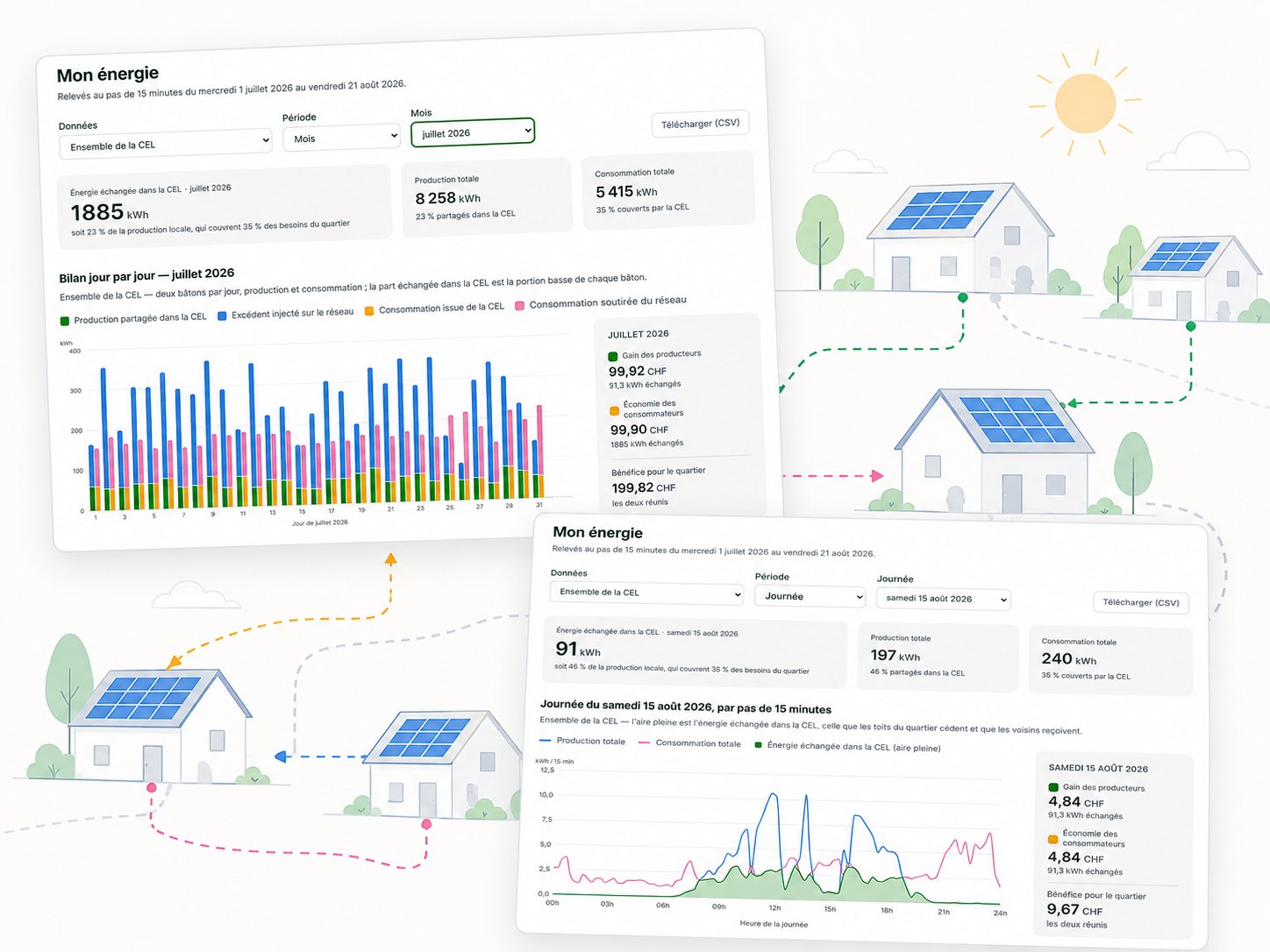
Real-time dashboard: kWh exchanged, cumulative savings in francs, CO₂ impact. Each member follows their own figures.
Exchange with other LEC members. Articles, videos, webinars: everything you need to understand and get the most out of your LEC.
The classification (20% or 40%) indicates the reduction in the transport charges for the electricity exchanged within the LEC.
More DSOs will be added soon (SIG, SIL, Viteos, OIKEN…)
Use the layer panel at the top right to turn the 20% and 40% groups on or off. Click on a zone to display its details. You can switch between the OpenStreetMap and Swisstopo base maps.
Submit your profile in 2 minutes. Celium automatically connects you with compatible neighbours in your grid zone.
Thank you! Your profile has been saved. Celium will analyse your zone and notify you as soon as a match is found.
In the meantime, share this link with your neighbours to speed up the creation of an LEC in your neighbourhood!
We believe in full transparency. Here is what an LEC can, and cannot, do for you.
Sell your solar surplus 50% higher than what the supplier (the DSO) offers
Save up to 30% on the energy consumed that comes from the LEC
A discount on network charges depending on the type of LEC chosen (40% if same transformer or 20% if same substation)
Consume local, renewable and traceable energy
Remain an individual customer of the supplier, with the option to leave the LEC at any time
Strengthen local solidarity and the energy autonomy of the neighbourhood
Beneficial for the supplier too: by encouraging local consumption, the LEC reduces the surplus injected into the grid, a technical and financial constraint that distribution system operators (DSOs) are precisely trying to limit
The LEC must be able to produce at least 5% of the total connection capacity. Without a producer, the LEC would have no benefit in any case.
The savings on the energy part as well as on the transport part only apply to exchanges within the LEC. When the producers do not generate enough, at night for example, electricity is consumed at the usual tariff.
Administrative management is complex → Celium takes care of everything
Billing is complex → Celium fully automates this process
A single subscription for the whole LEC (and not per member), which scales with your size. No commission on the energy exchanged.
Small LEC
Subscription paid by the LEC
+ CHF 10 per active member
Medium LEC
Subscription paid by the LEC
+ CHF 2 per active member
Large LEC
Subscription paid by the LEC
+ CHF 1 per active member
The price is billed to the LEC as a whole, not to each member individually. It scales automatically with the size of the community. All prices are in CHF, excluding VAT. No commission on the energy exchanged.
No need to appoint a manager: Celium handles the complete administration of your LEC (billing, compliance, relations with the DSO and flow tracking).
A Local Energy Community (LEC) is a grouping of electricity consumers and producers within the same municipality. Since 1 January 2026, Swiss federal law (art. 17d-17e LApEl) allows LEC members to share solar electricity over the public distribution grid, with a 20 to 40% discount on grid usage charges.
The Celium fee is a monthly subscription paid by the LEC as a whole, not by each member individually. It scales with the size of the community: CHF 9/month + CHF 10 per active member up to 6 members, CHF 59/month + CHF 2 per active member from 7 to 40 members, CHF 99/month + CHF 1 per active member above 40 members. No commission on the energy exchanged.
The 40% discount applies when LEC members are connected to the same transformer station (grid level 7 / NE7). This is the most favourable case. The 20% discount applies when members are connected to the same substation (grid level 5 / NE5) but not necessarily to the same transformer. Check the Celium interactive map to verify your zone.
Yes, you remain an individual customer of your electricity supplier. You can leave the LEC at any time, in line with the terms set out in the community agreement. You lose none of your rights as a consumer.
The law requires that the total production of an LEC be at least equal to 5% of the consumers' total connection capacity (art. 19e OApEl). For example, if the LEC consumers have a total connection capacity of 200 kW, at least 10 kWp of solar production is needed. Celium checks this threshold automatically for you.
The DSO (Distribution System Operator) is the company that operates the local electricity grid (cables, transformers, smart meters) and delivers electricity to your home. In practice, for the vast majority of households in French-speaking Switzerland, it is also your electricity supplier: the same company (Romande Énergie, Groupe E, BKW, SIG, etc.) handles both the grid and the energy billing. That is why we use the two terms interchangeably on this site.
Celium currently holds the topology data for three DSOs: Romande Énergie (Canton of Vaud, Lower Valais), Groupe E (Canton of Fribourg, parts of Vaud and Neuchâtel) and BKW (Bernese Jura, Seeland, Emmental). For the other DSOs (SIG, SIL, Viteos, etc.), Celium can submit the topology information request on your behalf.
Yes, every LEC participant must have a smart meter for 15-minute interval metering. If you don't have one yet, the DSO is required to install it free of charge within 3 months of the request.
"The hardest part was finding interested neighbours. Celium was a great help on that front. Once the group was formed, Celium handled all the procedures with the DSO and the billing runs on its own."
Marc L.
Consumer
"With my panels, I used to sell my surplus to the electricity supplier at about 7 ct on average. Now I sell it to my neighbours at 10 ct. It changes the profitability of my installation."
Sophie F.
Producer and consumer
"As a municipality, the idea of consuming locally and strengthening ties between neighbours seemed excellent to us. Celium supported us in creating LECs in our neighbourhoods."
Pierre D.
Municipal councillor
Anonymised testimonials from participants in the pilot programme.
FADP compliant
Swiss data protection
Hosted in Switzerland
Data on Swiss servers
SSL encryption
Secure communications
LEne legal framework
Compliant with the Energy Act
Do you have a question about LECs, about Celium, or about your particular situation? Write to us, we reply within 48h.
Would you like to join an LEC?
Use our matching form instead, it is faster and Celium will be able to analyse your eligibility automatically.
Submit my candidate profileThank you! We will reply within 48h to the address provided.
How it works
From your first idea to a working LEC, here is what you actually do.
I submit my profile
Address, role (consumer, producer or both), capacity: 2 minutes are enough. Celium identifies my DSO and my grid zone.
Celium connects me with my neighbours
Does an LEC already exist in my zone? I join it. Otherwise, Celium shows me the interested neighbours and checks that the group is viable (same grid, 5% threshold).
We form the LEC together
Celium generates the agreement, handles registration with the DSO and the digital signature. I have no administrative forms to fill in myself.
We recruit more neighbours
The larger the LEC grows, the greater the savings. Celium provides flyers, invitation links and a public showcase to attract new members.
Celium bills automatically
Every month, Celium imports the DSO data, allocates energy at 15-minute intervals, generates the bills with a Swiss QR-code and tracks payments.
I track my savings
Real-time dashboard: kWh exchanged, savings in francs, CO₂ impact, payment status. Celium handles everything for you.